
#03 - AI Is Rewriting the Rules of Personal Branding
The smartest professionals aren’t fighting AI. They’re using it to become impossible to ignore.
The Rules Changed. Most People Haven’t Noticed Yet.
Here’s something I want you to sit with for a moment.
Right now, when someone types your name or a question you should be answering, into ChatGPT, Google AI Mode, or Perplexity, one of two things happens.
Either you show up. Or someone else does.
There is no middle ground anymore.
In early 2026, AI search is no longer a trend coming down the road. It’s already here, and it’s already deciding who gets found and who stays invisible. A 2026 study found that 37% of consumers now begin searches with AI tools rather than traditional search engines. That number is climbing every month.
This changes everything about how personal branding works. And most experts, coaches, and professionals haven’t adjusted their strategy yet, which means there is a massive, open window of opportunity for those who act now.
That’s exactly what we’re unpacking today.
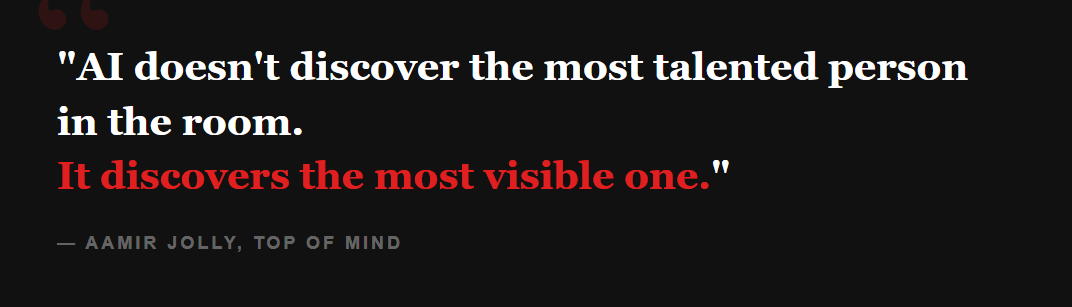
LinkedIn Just Became the Most Powerful Real Estate on the Internet
Between November 2025 and February 2026, something historic happened quietly. LinkedIn’s citation frequency on ChatGPT more than doubled, climbing from roughly #11 to #5 among all domains cited. And for professional queries specifically, LinkedIn is now the #1 most-cited source across every major AI platform: ChatGPT, Gemini, Google AI Mode, Microsoft Copilot, and Perplexity.
Researchers at SEMrush analyzed 325,000 unique AI prompts and found 89,000 LinkedIn URLs being cited in AI-generated responses. The findings are hard to ignore:
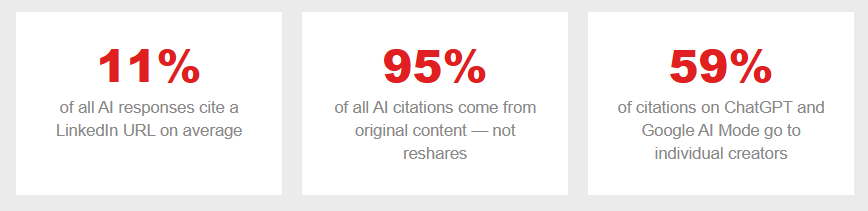
Here’s the part that should wake you up: most cited posts only had 15 to 25 reactions. AI doesn’t care about viral posts. It cares about consistent, substantive, original content from real people.
Your LinkedIn profile page? Citations to profiles actually dropped from 33.9% to 14.5%. It’s your content, your posts, your articles, your thinking, that AI is now using to decide who is an authority.
AI Is Separating Experts from Imposters - Faster Than Ever
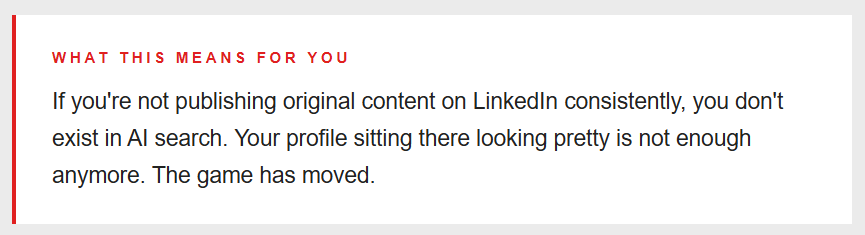
Here’s the paradox of 2026: AI makes it easier than ever to produce content. Anyone with ChatGPT can generate 10 posts in an hour. But that’s exactly why generic, AI-written content is becoming worthless.
Scroll through LinkedIn today and you’ll see the same phrases, the same structures, the same advice recycled with slightly different profile pictures. Researchers from Entrepreneur described it bluntly: content that sounds like it could have come from anyone does more damage than silence.
Meanwhile, the people who are winning are doing something different. They’re using AI as a tool to amplify their own thinking, not to replace it.
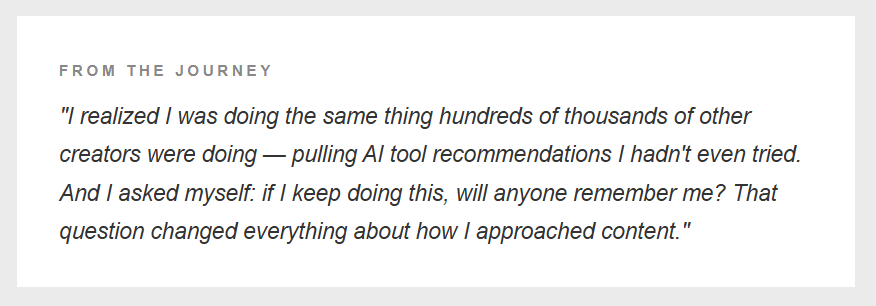
I went through this exact transition myself. Early in my content journey, I was generating scripts with ChatGPT and memorizing them like exam notes. I knew marketing deeply, I’d been in the industry for years. But I hadn’t yet learned how to make my thinking visible in my own voice. And honestly? The content felt hollow. No real traction. A few likes from friends. Nothing more.
The shift happened when I stopped letting AI write my ideas and started using it only to structure and sharpen thoughts that were already mine. That’s when my content started connecting. That’s when people started reaching out. That’s when LinkedIn started working while I slept.
What’s actually working in 2026
The Three-Part Formula for AI-Powered Personal Branding
Based on everything the research shows and everything I’ve tested firsthand, here’s how the strongest personal brands are being built right now:
Use AI to scale your ideas, not replace them
Start with your own thinking, your own experience, your own take. Then use AI to help you structure it, expand it, or repurpose it across formats. Your lived experience is what AI cannot replicate and it’s exactly what AI search platforms are now rewarding. AI can assist with research and organization. But the thinking itself must stay human. That is the true differentiator in 2026.
Publish for depth, not volume
The SEMrush data is clear: articles between 500 and 2,000 words attract the most AI citations, accounting for 50% to 66% of all LinkedIn citations depending on the platform. For shorter posts, 200 to 300 words is the sweet spot. You don’t need to post every day. You need to post with enough depth that AI can extract a real answer from your content. One substantive post beats five shallow ones every time.
Be consistent in your language and positioning
AI search works by identifying named entities and understanding their relationships. When your content uses consistent, precise language, the same terms, the same framing, the same niche, AI learns who you are and what you stand for. Flip-flopping between different angles or identities confuses the algorithm and dilutes your authority. Pick your positioning. Own it. Say it repeatedly. That’s how you become the name AI associates with your space.
The bigger picture
The Human Premium Is Now Your Biggest Competitive Advantage
As AI-generated content floods every platform, something fascinating is emerging researchers are calling it the Human Premium. Audiences are developing a sixth sense for automation. Polished, perfectly optimized content feels distant. Real stories, real doubt, real imperfection, those feel trustworthy.
In other words: your quirks are your moat. Your journey is your edge. The experiences that make you, you – those are the things AI will never be able to write.
Authenticity is not a soft, feel-good concept anymore. It’s a hard competitive advantage.
The brands and individuals winning in 2026 are the ones who combine smart AI systems with genuinely human storytelling. Not one or the other. Both.
⚡ Win in 10 minutes
Do this today to start showing up in AI search
Step 1: Open LinkedIn and write a 200–300 word post answering one question you get asked often in your field. Lead with the question. Answer it clearly. Use your exact industry language consistently.
Step 2: Make sure your LinkedIn headline uses your precise niche terms, not vague ones. If you want to be known for “personal branding for coaches,” don’t write “helping people grow.” Be exact.
Step 3: Commit to posting at least 5 times this month. The research shows 75% of AI-cited authors post 5+ times per month. Consistency signals authority to AI systems. Start the habit today.
Bonus: Write one LinkedIn article this week, minimum 500 words, going deep on a topic in your niche. Articles are the highest-cited content format across every AI platform right now. This single move compounds over time.
The window to get ahead of this is still open. Most professionals have not adjusted their LinkedIn strategy to account for AI search. The ones who do it now will build an authority position that compounds, just like LinkedIn’s own citation rank doubled in three months and kept climbing.
Your expertise already exists. The system is now being built to surface it, if you give it enough signal.
Start giving it that signal. Today.
Ready to build the brand that AI and people can’t ignore?
Inside the Brand Authority Room, you’ll get the exact frameworks, systems and strategies I use to help experts get found, followed, and paid.